The CDC National Institute Occupational Safety and Health (NIOSH) defines workplace violence as “violent acts (including physical assaults and threats of assaults) directed towards persons at work or on duty”.

The U.S. Department of Labor defines workplace violence as an action (verbal, written, or physical aggression) intended to cause (or is capable of causing) death or serious bodily injury or damage to property.

The Sentinel Event Alert is a publication of the Joint Commission, and issue 59 focuses on physical and verbal violence, but explains that “there is a whole spectrum of overlapping behaviors that undermine a culture of safety”. Each incident of violence or credible threat to healthcare workers warrants creating an incident report, and notifying:

  • leadership
  • internal security
  • law enforcement (where necessary)

Action Products for decades have advocated for nursing professionals, and it is very disconcerting to read articles such as this one in a recent issue of Modern Healthcare: Healthcare workers face violence epidemic
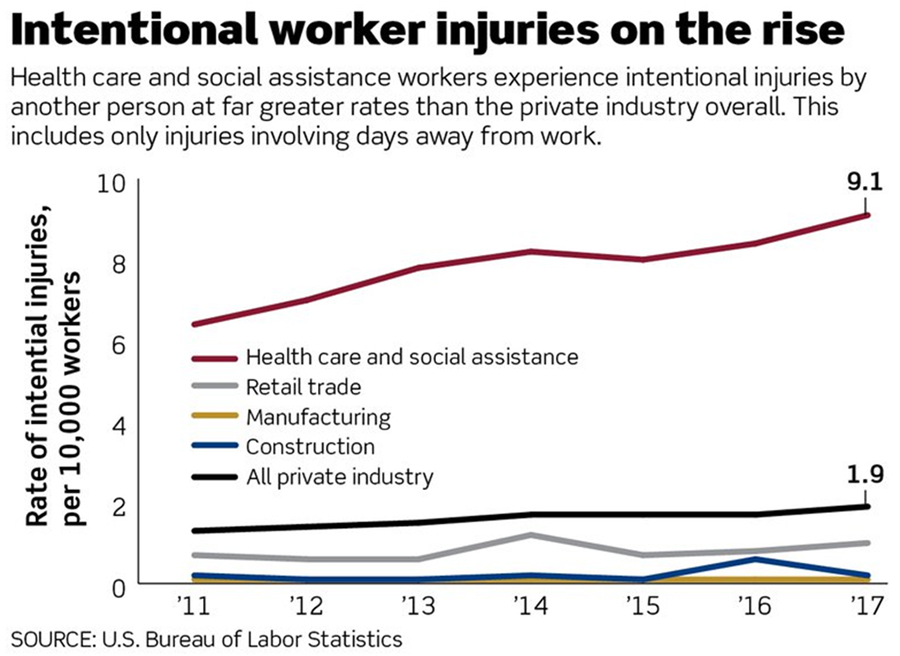
Chart: Intentional worker injuries on the rise - US Bureau of Labor Statistics

Federal data shows, as author Lydia Coutre points out, workplace violence happens at far greater rates in the healthcare sector than it does in the private sector overall.  In 2018, Cleveland Clinic confiscated 30,000 weapons from patients and visits in the Northeast Ohio region alone! The problem, Coutre explains, is that hospitals must strike a balance between security concerns and offering easily accessibility to patients and their visitors.

The Joint Commission offers a Workplace Violence Prevention Resources for Healthcare page where nurses can turn for information and support.

The Joint Commission also provides a printable infographic Take a Stand: No More Violence to Health Care Workers  that can be printed and posted in facilities.

Read More Action Product Blogs…

Pressure Injuries: Never Events – Part 1

Preventing Hospital-Acquired Pressure Injuries in 2026: Perioperative Strategies to Avoid CMS Never Events Hospital-Acquired Pressure Injuries (HAPIs) remain a costly and preventable harm. The Centers for Medicare & Medicaid Services (CMS) still classifies Stage...

Heel Pressure Injury Prevention with Evidence-Based Interventions!

Mitigate the risk of a heel pressure injury The supine position is the most common surgical position with the patient lying on their back with the head, neck and spine in a neutral position. This position is not without pressure injury risk as there is increased...

National Patient Safety Goals, Universal Protocol: Guideline for Perioperative Team Communication

Each year the Joint Commission, with input from practitioners, provider organizations, purchasers, consumer groups, and other stakeholders, determines high priority patient safety issues and creates National Patient Safety Goals (NPSG). NPSG were established in 2002...

November 20 is Pressure Injury Prevention Day!

The annual Worldwide Pressure Injury Prevention Day is November 20, 2025.  Don’t forget that perioperative pressure Injury prevention strategies decrease hospital acquired pressure injuries (HAPIs) in non-reimbursable CMS “never event” category. Awareness around...

Preventing Pressure Injuries Is Essential in Home Healthcare

For individuals with physical disabilities receiving care at home, preventing pressure injuries (also known as pressure ulcers or bedsores) is not just important, it’s critical to maintaining health, comfort, and independence. As Susan Lipton Garber noted in the...

Tips to Reduce Surgical Site Infections

Surgical site infections (SSI) are multifaceted, meaning that there are many intrinsic and extrinsic factors that contribute to them. Unfortunately, it is difficult to track down the source of infection because of all the factors in play. Is it the traffic in the OR...

Choosing the right-size Chest Roll

Chest Rolls for Prone Position: Assess Your Surgical Patient’s Needs Protecting your patient in the prone position requires assessing the patient’s needs for that surgery. In this blog we will talk about the correct positioning and different uses for the chest roll...

Pressure Injuries Can Affect Patients for a Lifetime

Hospital acquired pressure injuries (HAPI) can cause severe pain and even death to the patient. When HAPIs are discussed among healthcare managers, cost comes first to mind. However, there are other concerns healthcare workers should consider. First and foremost is...

Enhancing Patient Safety with Viscoelastic Gel Overlays in Surgical Positioning

Surgical nurses play a critical role in protecting patients from positioning-related pressure injuries during surgical  procedures. One of the most effective tools to support this mission is the viscoelastic gel overlay, a material designed to reduce pressure, enhance...

Take the Time for a “Time Out”

The “Time Out” The “time out” is one part of the Universal Protocol developed by the Joint Commission to prevent wrong-site, wrong-procedure, and wrong-person surgery. Each are considered never events by the National Quality Forum and sentinel events by the Joint...